
1. How one circle becomes nineteen
If you place the point of a compass on a blank sheet of paper and draw a single circle, you have drawn a boundary without beginning or end. In classical geometry and spiritual tradition alike, that first circle stands for unity — the One from which every proportion unfolds.
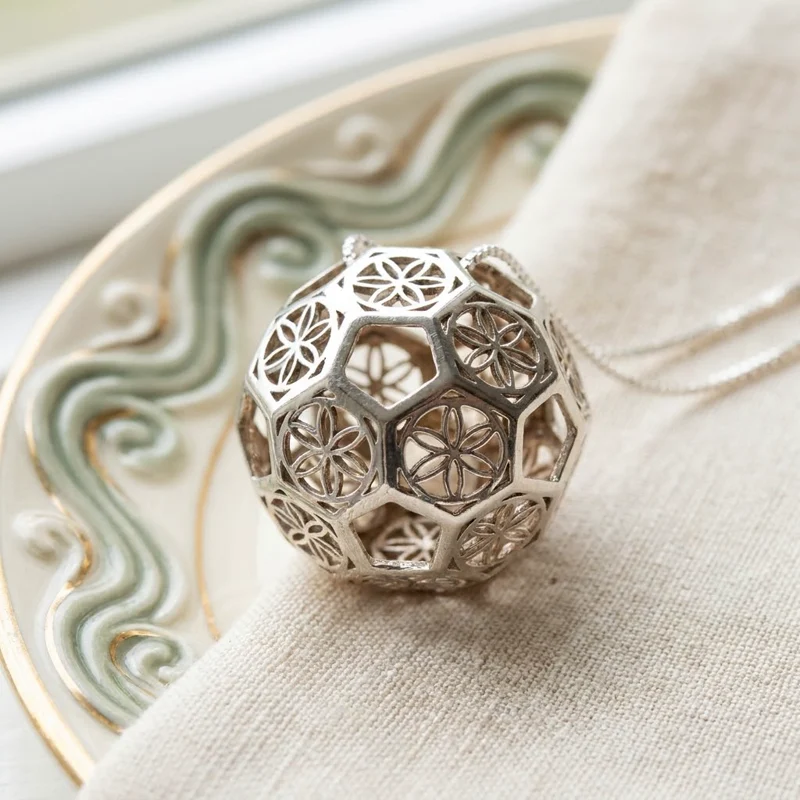
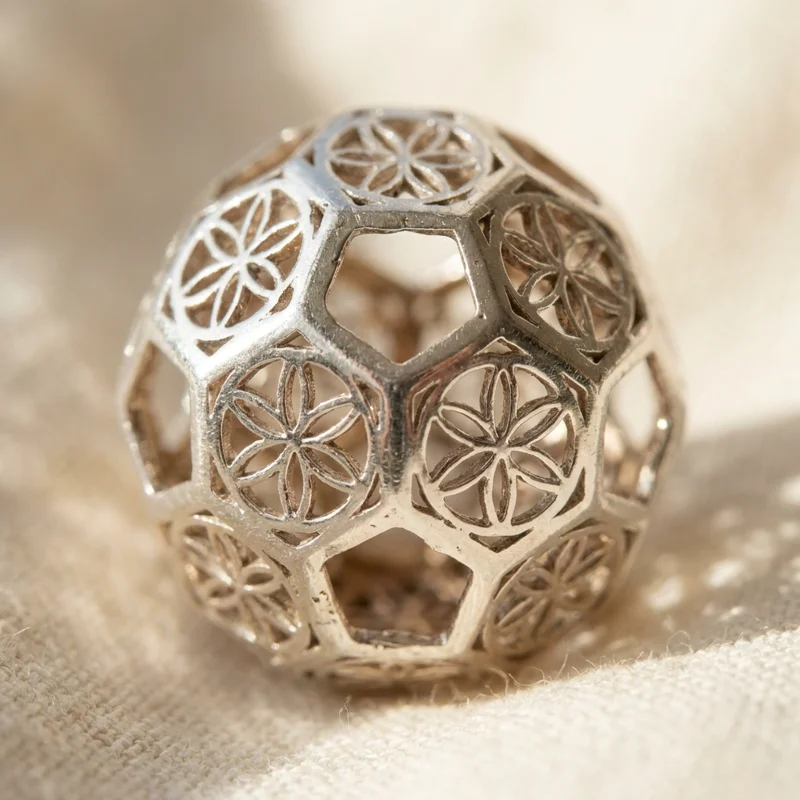
When you place the compass point on the rim of the first circle and draw a second circle of the exact same radius, their intersection creates an almond-shaped lens in the middle: the Vesica Piscis. Add five more circles around the center, each touching the middle point, and a six-petaled flower appears inside the first ring. Tradition calls this seven-circle figure the Seed of Life.
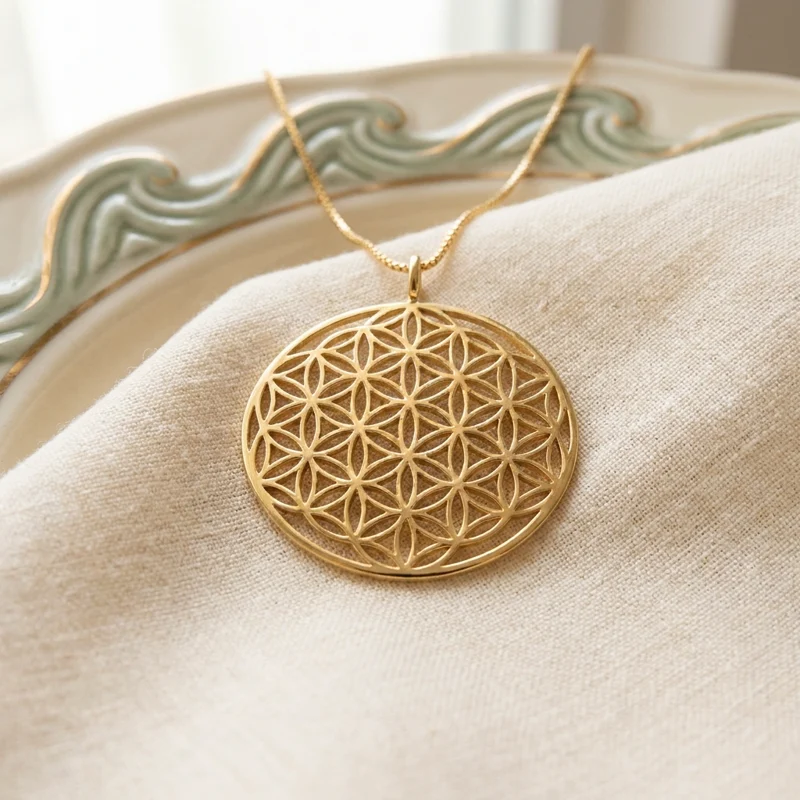
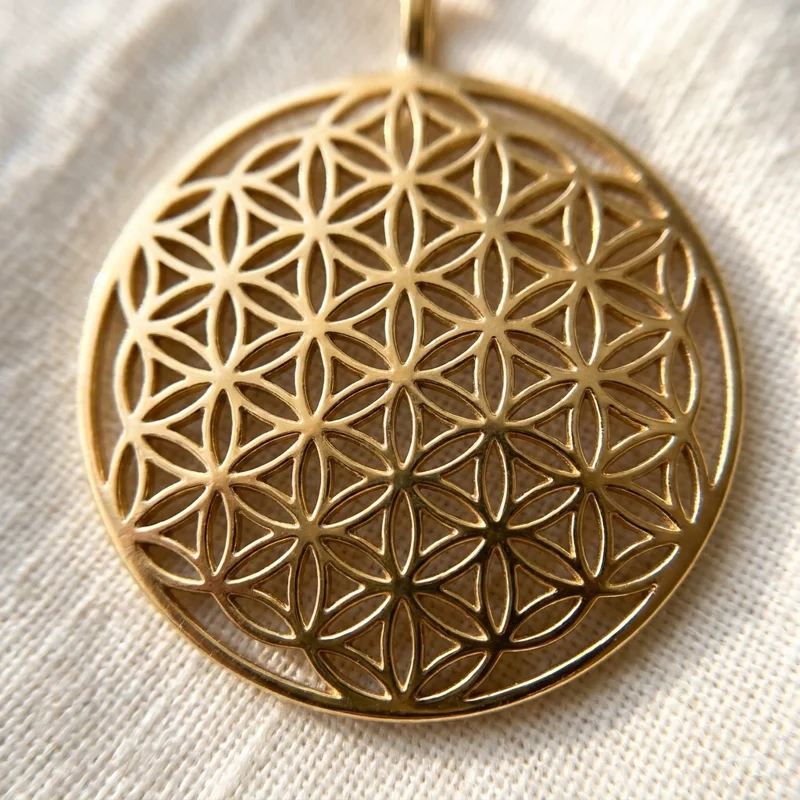
Continue expanding outward with the same radius until nineteen full circles are enclosed within an outer ring, and you hold the complete Flower of Life. Nothing is forced or measured with a ruler; every intersection arises naturally from keeping the radius constant.
Geometry is vibration made visible — the quiet order underneath the world we touch.
2. Where history left the pattern in stone and ink
What makes the Flower of Life remarkable to historians of art and mathematics is that no single culture owned it. Because anyone with a compass or a piece of string can discover the six-fold symmetry of equal circles, independent traditions arrived at the same emblem and gave it a place of honor.
In Upper Egypt, on the massive granite pillars of the Osireion behind the Temple of Seti I at Abydos, clear multi-circle grids were drawn in red ochre on the stone. Across the Mediterranean, Roman floor mosaics and carved sarcophagi used the six-petaled rosette and overlapping circle grids as emblems of cosmic order. Later, medieval cathedrals in Italy and Spain and intricate geometric screens in Islamic architecture wove the same six-fold grid into marble and wood.
During the Renaissance, Leonardo da Vinci filled sheets of the Codex Atlanticus with studies of the Flower of Life and the Seed of Life, exploring the lunulae (crescent proportions) and the ratios formed where the circles cross.
- The Vesica Piscis (2 circles): the lens where two equal circles meet, carrying the square root of 3 in its length-to-width ratio.
- The Seed of Life (7 circles): one central circle surrounded by six, the first ring of symmetry.
- The Flower of Life (19 circles): nineteen overlapping circles framed by a double outer circle.
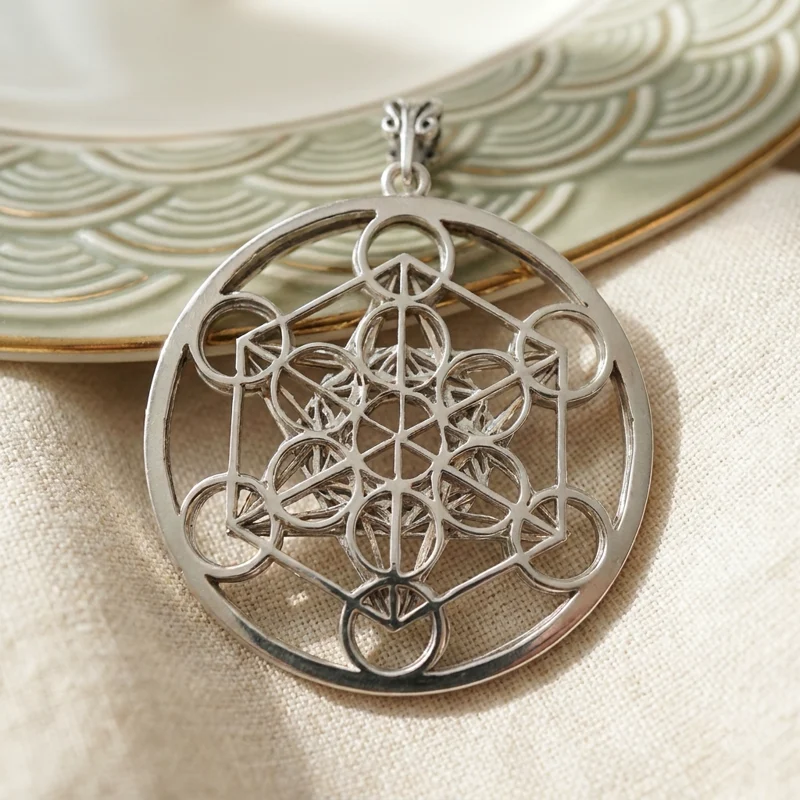
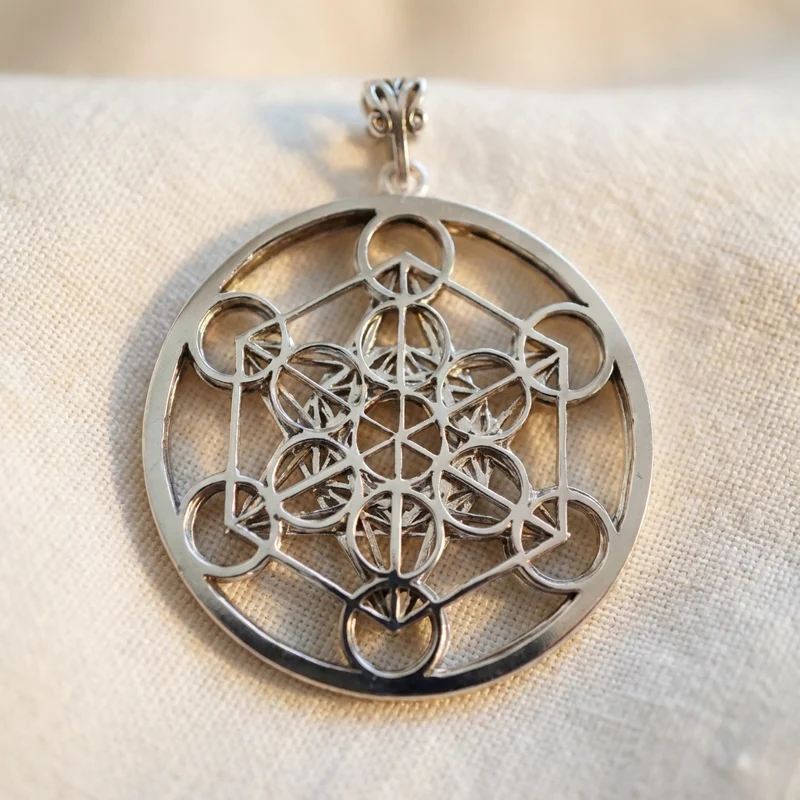
- The Fruit of Life & Metatron's Cube (13 circles): extending the grid reveals thirteen tangent circles; connecting their centers with straight lines traces all five Platonic solids.
Visual guide
From one circle to the Seed of Life, the Flower of Life and Metatron's Cube
3. From flat circles to the five Platonic solids
In his dialogue Timaeus, Plato described how the classical elements of the cosmos — fire, earth, air, water and the overarching heavens — correspond to the five regular three-dimensional polyhedra: the tetrahedron, the cube, the octahedron, the icosahedron and the dodecahedron.
When students of sacred geometry extend the Flower of Life to thirteen circles (the Fruit of Life) and join the center of every circle to the center of every other with 78 straight lines, the resulting figure is Metatron's Cube. Seen in two dimensions, those 78 lines contain the exact orthographic projections of all five Platonic solids.
| Sacred form | Circles / faces | Portal & sign in our cosmology | Guardian frequency |
|---|---|---|---|
| Vesica Piscis | 2 overlapping circles | Portal 3 (Gemini) & Portal 12 (Pisces) | 639 Hz |
| Seed of Life | 7 circles (1 + 6) | Portal 11 · Aquarius (New beginnings) | 396 Hz |
| Flower of Life | 19 circles in outer ring | Portal 2 · Taurus (Connection) | 639 Hz |
| Metatron's Cube | 13 centers · 78 lines | Portal 5 · Leo (Protection) | 741 Hz |
| Tetrahedron | 4 triangular faces | Portal 1 · Aries (Courage) | 417 Hz |
4. Sound, water and visible symmetry
Why do geometric patterns feel so familiar when we listen to calm, sustained tones? We keep science as science and tradition as tradition, yet the two offer a striking visual parallel.
In 1787, the physicist Ernst Chladni drew a violin bow across the edge of a metal plate dusted with fine sand, showing that pure acoustic pitches organize loose particles into symmetrical nodal stars and rings. In the twentieth century, Hans Jenny photographed water and fine powders vibrating at specific frequencies — a field he named cymatics — revealing six-fold and twelve-fold wave lattices as the tone held steady.
Cymatics is physical acoustics; the Flower of Life is geometric tradition. Placing them side by side reminds us why contemplative cultures saw geometry and music as two mirrors of the same harmony.
Try it today
A 3-step visual and sound practice
You do not need to be a mathematician to use sacred geometry as an anchor for focus and inner calm. Try this five-minute practice before a session:
- Rest your eyes on the center. Look at the central circle of the Seed or Flower of Life for three slow breaths, letting your gaze soften instead of counting the petals.
- Follow one ring outward. Trace the six surrounding circles with your eyes in a slow clockwise motion, noticing how every circle supports the ones beside it.
- Close your eyes and listen. Press play on a 639 Hz (Taurus · Flower of Life) or 396 Hz (Aquarius · Seed of Life) session and keep that quiet sense of symmetry as the music unfolds.
Guardian frequency session · 639 Hz · Taurus & the Flower of Life
Listen while you contemplate: 639 Hz Heart & Connection Session
Nearly an hour of original ambient music tuned around the 639 Hz guardian frequency — associated in our twelve-portal cosmology with Taurus, Earth and the Flower of Life.
Questions & answers
Frequently asked questions
How many circles are in the Flower of Life?
The classic Flower of Life contains 19 full overlapping circles of equal radius, surrounded by 36 partial arcs that complete the hexagonal pattern inside a double outer boundary ring.
What is the difference between the Seed of Life and the Flower of Life?
The Seed of Life is the first stage of seven circles (one center circle surrounded by six). The Flower of Life expands that same grid outward to nineteen full circles.
Where is the oldest known Flower of Life carving?
Among the best-known ancient examples are the red-ochre geometric circles on the granite pillars of the Osireion at Abydos in Egypt, alongside early Assyrian, Phoenician and Roman geometric art.
How does Metatron's Cube come from the Flower of Life?
Extending the Flower of Life grid reveals thirteen tangent circles called the Fruit of Life. Drawing straight lines from the center of each of those thirteen circles to every other center creates Metatron's Cube.
Which zodiac portal carries the Flower of Life in Alpha & Omega?
In our twelve-portal cosmology, Portal 2 (Taurus, Earth, guided by Chamuel in angelic tradition) carries the Flower of Life and the 639 Hz guardian frequency of connection.
Sources & traditions
- Plato, Timaeus (c. 360 BCE), sections 53c–56c — construction of the regular polyhedra and the classical elements.
- Leonardo da Vinci, Codex Atlanticus (fol. 307r–309v, Biblioteca Ambrosiana, Milan) — compass studies of overlapping circles and lunulae.
- Ernst Chladni, Entdeckungen über die Theorie des Klanges (1787) — acoustic nodal figures on vibrating plates.
- Hans Jenny, Cymatics: A Study of Wave Phenomena and Vibration (1967) — photographic studies of standing waves in water and particulates.
 Elijah